Fertilization
Fertilizing is crucial to a nice lawn, as keeping turf healthy by providing nutrients will not only make it nicer, but also less susceptible to disease and thicker to crowd out weeds.
In understanding fertilization, it is good to understand a bag of fert:
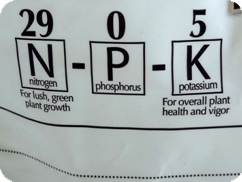
- Fertilizer Bag Analysis : percentages of N (Nitrogen), P (Phosphorus), and K (Potassium) in the bag.
- N,P,K are macronutrients of turf – the plant needs these nutrients the most. N makes it green and grow, while P and K make the plant and roots stronger.
- P is mainly used for starter fert, although a little for the plant is good – an abundance can run off to surface water, so many fertilizers have none, and some states have outlawed the use of P in lawn fert. The issue has been addressed by Purdue seen here:
https://www.extension.purdue.edu/extmedia/AY/AY-334-W.pdf
Since providing N is providing food for turf, one does not want to over feed turf as it is unhealthy for the turf, similar to eating more than one should at a buffet. Thus, one adheres to a diet, which, in turf, is utilizing a controlled-release fertilizer, defined in Wikipedia, is:
"...a granulated fertilizer that releases nutrients gradually into the soil."
Benefits of using Controlled-Release Fertilizer:
- "...consistent, controlled feeding also eliminates the feast/famine cycle that contributes to stress, so turf is more resistant to weeds and diseases, which promotes lush, green growth." (Ron Hall, Controlled-Release Ferts Offer Many Advantages)
- "No growth surge reducing the need for bagging or double-cutting during turf high-growth periods" (Ron Hall, Controlled-Release Ferts Offer Many Advantages)
One of the most effective and cost efficient controlled-release fertilizer formats is poly coated sulfur coated urea that feeds for 2-3 months:
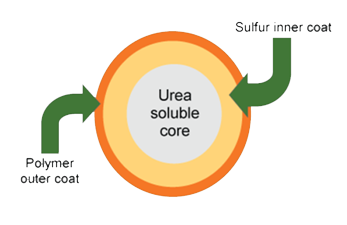
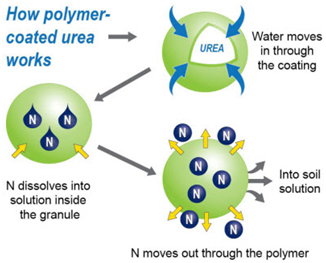
Polymer coated ureas are also preferred long-term controlled-releases that can last 4-6 months, don't burn during hot, dry times, but cost more. The coating has minute orifices that expand during heat that allow water, when available, to move in, dissolve urea, and travel back out:
In understanding the percentage of controlled-release N in a bag of fert, observe the following label:
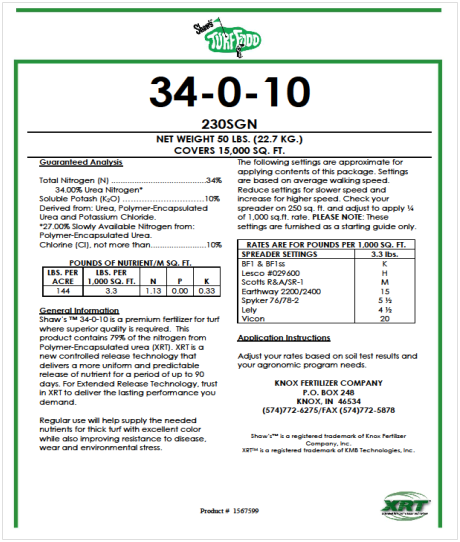
On this Shaw's fertilizer label, one can see that 27% of the 34% of N in the bag is encapsulated to make it a controlled-release. 27/34 = .79. This means CR79%, or that 79% of the N in the bag is a controlled release. CR's range from a small amount up to 100%.
Amounts of N to provide are specified per the time of the season, with a lawn season total of about 2-3lbs N and about twice that amount for athletic fields:
| Sept 15 | 21-3-21 SOP CR50% | 4.1lbs/M | 8 bags | .86 | .12 | .86 |
Since bag analysis is 21% N, we multiply .21 by rate 4.1 to get .86 pounds of N per that application and likewise with P and K.
Purdue provides a detailed, free download about lawn fertilization:
https://www.extension.purdue.edu/extmedia/AY/AY-22-W.pdf
Fertilization Dr. Cale Bigelow:
https://www.youtube.com/watch?v=Ih0Zp1Erblk
Color Dr. Zac Reicher:
https://www.youtube.com/watch?v=zPzkzbBn184
Controlled Release Fertilizers:
https://www.cdfa.ca.gov/is/ffldrs/pdfs/Ellison_Eric.pdf